You spend $200 — sometimes $600 — on a single salon visit. Then you walk out, and over the next eight weeks, you wash your hair roughly forty times with whatever shampoo and conditioner sit on your shower shelf.
If those forty washes are working against the salon protocol, the protocol loses. Every time. The math is not subtle.
What's actually different about professional haircare
Drugstore shampoos and "professional" salon shampoos are not the same product at a different price point. The differences are formulation-level, and they're concentrated in three places:
The surfactant system
Surfactants are what make shampoo clean. The cheapest, most effective surfactant is sodium lauryl sulfate (SLS). It works. It also strips the cuticle aggressively and dissolves color molecules.
Professional formulations almost always replace SLS with milder surfactants — coco-glucoside, sodium cocoyl isethionate, decyl glucoside — that clean less aggressively but preserve the lipid layer your hair actually needs.
The conditioning agents
Drugstore conditioners are heavy on silicones — dimethicone, in particular — which coat the hair to simulate softness. The hair feels great in the shower. Six washes later, the silicone has built up, weighed the lengths down, and prevented any actual moisture from reaching the cortex.
Professional formulations use silicones that are water-soluble (look for "PEG-modified" forms) and rely more on plant butters, hydrolyzed proteins, and ceramides — ingredients that interact with the hair structure rather than coating it.
The actives
This is where the gap is largest. Bond-builders, peptide complexes, low-molecular-weight hyaluronic acid, panthenol at concentrations that actually do something — these are expensive ingredients that drugstore margins cannot accommodate.
A 6-ounce bottle of professional shampoo costs more not because the brand is more aspirational, but because the formula contains ingredients that cost an order of magnitude more per gram.
"Salon-quality" at the drugstore — the asterisk
Many drugstore brands now market themselves as "salon-quality." Read the ingredient list. The first five ingredients are nearly always: water, sodium lauryl sulfate (or laureth), sodium chloride, fragrance, and a basic conditioning agent. The "salon" hero ingredient — the one on the label — is usually present at under 0.5%, far below the threshold where it does anything measurable.
The first five ingredients tell you what the product actually is. The last fifteen tell you what the marketing wants it to look like.
Why a salon that makes its own line is different
Most salons resell. They pick a professional brand from a distributor catalog, put it on a shelf, and earn a margin. The products are usually good — but the salon is one customer of the brand, not the author of the formula.
A salon that makes its own line is doing something fundamentally different. Every formula is a direct answer to a problem the stylists actually see in the chair. When the protocol changes, the formula changes with it. There's no gap between what the salon recommends and what the salon believes — because they wrote both.
What this looks like in practice
- The shampoo used during your salon wash is the same one you take home. Not "similar" — the same.
- The treatment masked into your hair at the appointment is dose-matched to a take-home version, so you continue the same active overnight, weekly.
- When the climate or season shifts (Miami summer vs. Miami winter — yes, there is a difference for hair), the salon updates its line and updates your protocol.
- Allergies, sensitivities, color-specific issues are addressed by reformulating, not by sending you to a different brand.
It's a slower business model. It's the only one that actually delivers continuity between salon and home — which is the only way long hair stays long, healthy, and luminous over years instead of months.
The Wonderlong Line
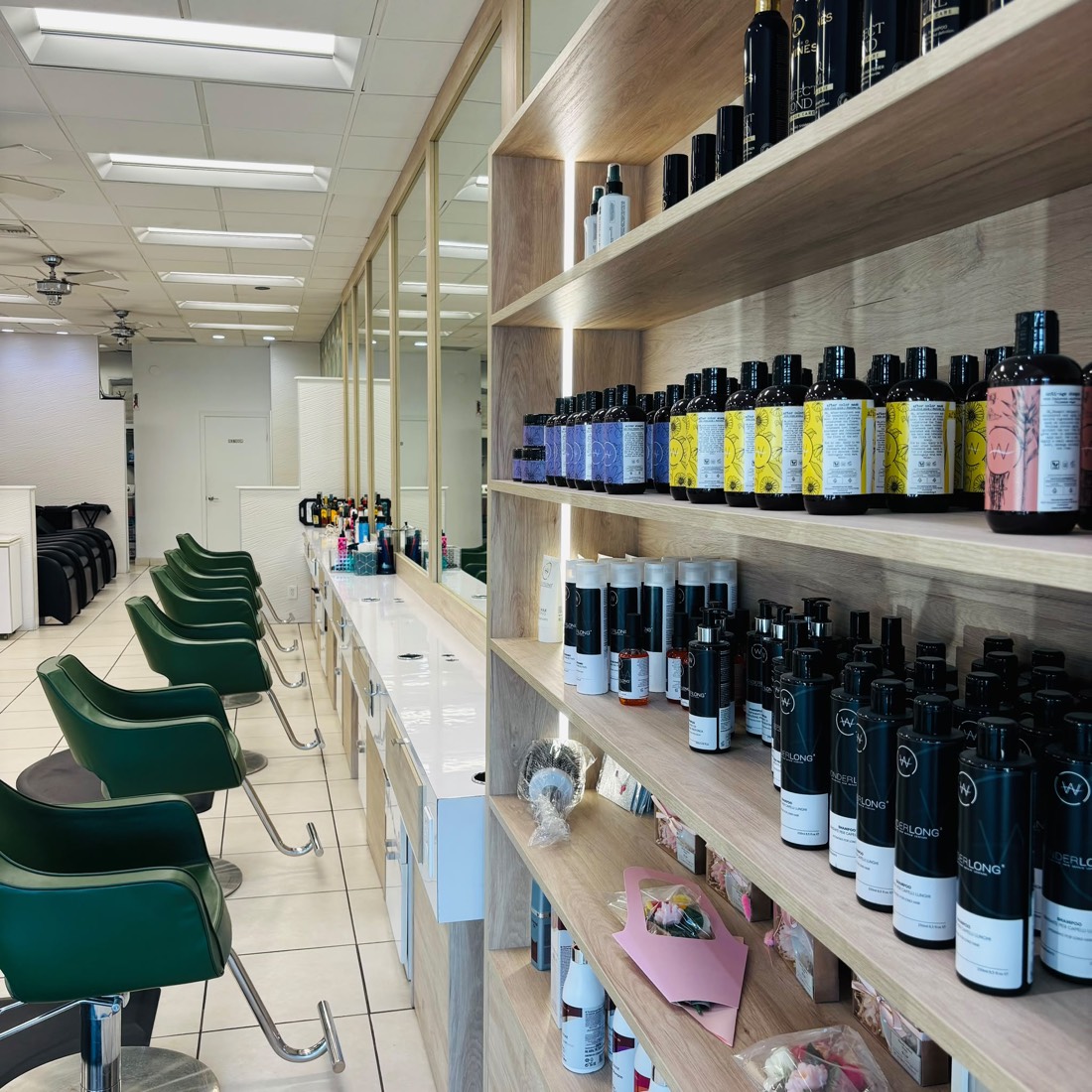
We developed our haircare line in Italy over twenty years of long-hair fieldwork, and reformulated it for the South Florida climate when we opened in Aventura. Sulfate-free across the entire range. Bond-builders dosed at therapeutic levels. Heavier hydration than European baselines. Humidity-resistant styling.
The line is sold exclusively at the salon — not on Amazon, not at department stores, not at distributor websites. If you're using Wonderlong products at home, it's because someone at our salon prescribed them to you specifically.
Curious what your hair would respond to?
Every appointment includes a free diagnostic and a personal product plan.